
Why Almost Every Analysis of Bol Ads Begins Wrong
In many analyses of bol ads, we see the same pattern repeatedly.
A dashboard is opened.
Numbers are reviewed.
And almost immediately, the same conclusion follows.
The ACOS is too high.
That feels logical. ACOS is visible, concrete, and confronting. Yet, this is exactly where many advertising analyses start incorrectly.
ACOS is rarely the real problem.
It is a result of everything that happens beforehand within bol ads.
Starting an analysis at ACOS means beginning at the end of the process and missing the causes that actually drive performance. The consequence is that optimization turns into reacting rather than targeted improvement.
We constantly see this pattern in bol ads.
Bids are lowered while the problem lies within the listing
Campaigns are turned off while they are collecting valuable data
Results are assessed without context
The analysis focuses on cost, not behavior.
ACOS tells what happens, but not why it happens.
A high ACOS within bol ads can be caused by:
insufficient visibility
low relevance
incorrect search intent
a product page that doesn't convince
Yet, these factors are often not examined simply because the focus shifts too quickly to cost.
Where a Good Analysis of Bol Ads Truly Begins
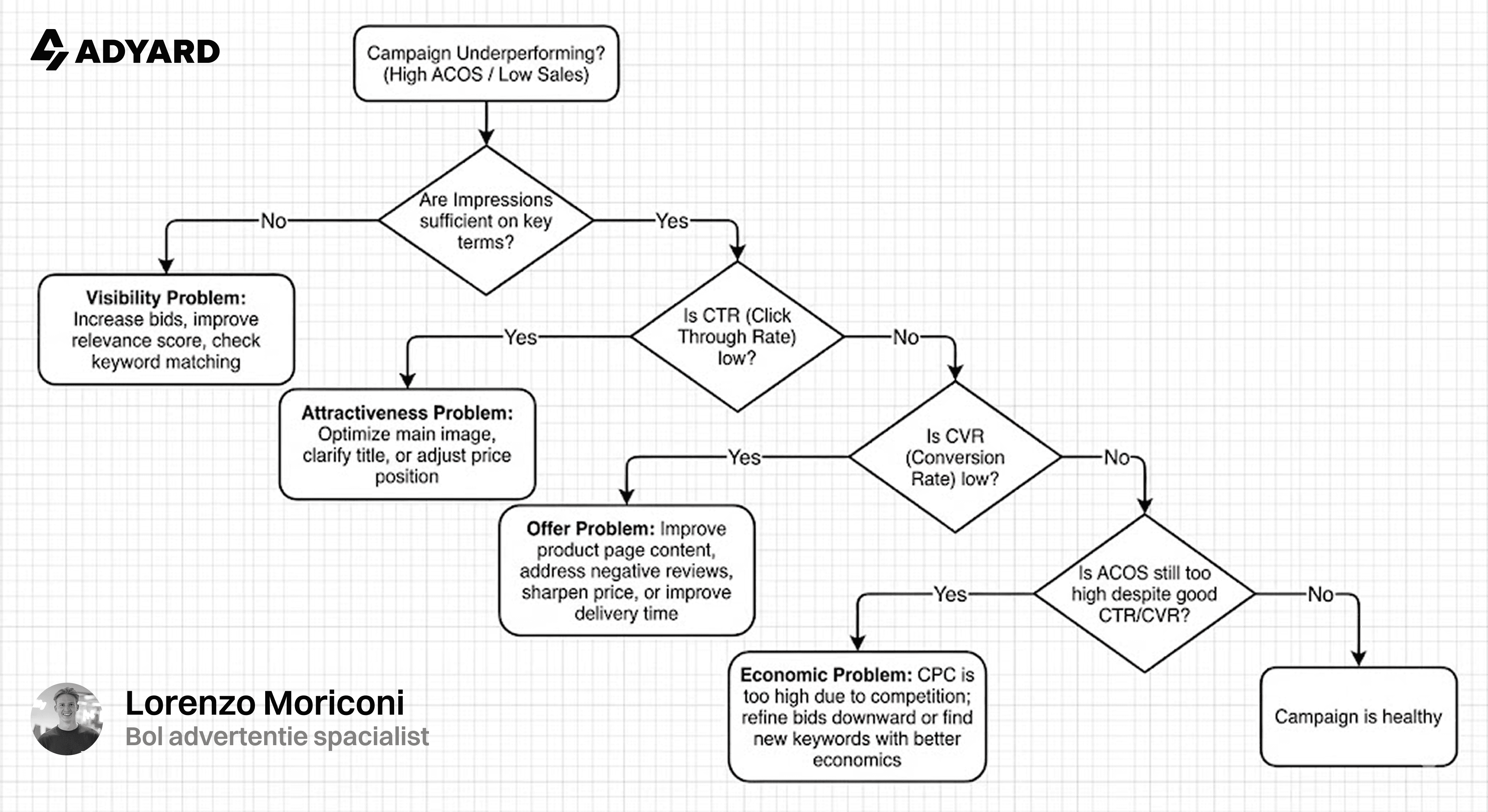
A strong analysis of bol ads does not follow the order of the dashboard but the user's journey.
Everything begins with visibility.
Is the ad even shown within bol? Without impressions, there is no data, and without data, there is nothing to optimize. Low visibility often indicates a mismatch between product and search term or insufficient relevance within the algorithm.
Then comes attractiveness.
Is there a click when the ad is shown? If ads are visible but hardly receive clicks, the problem rarely lies with the campaign settings. In most cases, it lies in the title, the main image, or the positioning relative to competitors within bol.
Only then does conversion come into play.
What happens after someone clicks? Here often lies the greatest leverage within bol advertising. Poor reviews, a non-competitive price, or a unclear product page ensure that even cheap clicks become expensive.
Only when these three components align does ACOS gain meaning.
In a healthy ad funnel, ACOS largely follows naturally.
If one of these links is weak, ACOS remains a symptom rather than a guiding tool.
What often troubles advertisers on bol is that ads are judged without context. The stage of the product, the role of ads within the overall bol strategy, and the underlying search intent are ignored.
The result is instability.
Fluctuating results.
And the feeling that bol ads suddenly stop working.
In reality, there is no lack of tactics, but a lack of structure in analysis.
Strong bol advertising is not about adjusting individual knobs, but about understanding the system as a whole. Search intent, relevance, product economics, and listing quality together determine whether ads on bol can perform sustainably.
To Optimize Better, One Must Learn to See Differently
True optimization of bol ads does not start with lowering costs but with understanding what truly happens within campaigns.
ACOS is an outcome, not a starting point.
By basing analyses of bol ads on structure rather than individual metrics, optimization becomes predictable, scalable, and sustainable.
Those who stop reacting to figures and start understanding make the difference in bol advertising.


